Plasma & Coating
Flexible atmospheric pressure (AD) plasma tool for functionalisation
The surface of a material does not always have the desired properties. A material that is inexpensive to process may have surface properties that are unsuitable for further processing (such as poor wettability).
Surface functionalisation involves depositing functional chemical groups on the substrate. These groups can influence the properties of the interface, such as adhesion, hydrophobicity and hydrophilicity, and provide an industrially favourable/easy-to-process product with a surface that the material does not have on its own.
Functional groups can be applied using a wet chemical process, a low-pressure process or an atmospheric pressure process. The low-pressure process, which is not usually suitable for in-line use, generally requires costly vacuum units, while the wet chemical process is harmful to the environment and incurs disposal costs for chemical waste products. The creation of functional groups on substrate surfaces using atmospheric pressure plasma sources can be carried out over a large area or locally. The potential for use in the ongoing production line and the low costs, especially when air is used as the process gas, are advantageous for industry. A special form is coating; plasma polymerisation.
An atmospheric pressure (AD) plasma tool operated with air as the carrier gas is used as the plasma source.
Important properties of industrial substrates can usually only be obtained by applying a suitable coating. The range of possible coatings for specific applications is broad: electrically insulating layers, gas barrier layers, antibacterial layers, hydrophobic or hydrophilic layers are just a few examples. In AD plasma polymerisation, the molecules of organic starting substances are fragmented, ionised and partially oxidised in an open plasma. The molecular fragments condense on the substrate surfaces, where they form a uniform, adhesive, closed and usually electrically insulating layer. The physical and chemical properties of the layers can be adjusted within a wide range using the deposition parameters.
Precursor: HMDSO
A commonly used precursor for plasma polymerisation at atmospheric pressure is the organosilicon compound hexamethyldisiloxane (HMDSO). It can be used to produce a-SiCOH layers with properties between those of polysiloxane (“soft, polymer-like”) and quartz glass (“hard, gas-like”).
Precursor fragmentation in the plasma zone is decisive here (Figure 1); For example, at high plasma intensities (high plasma power, short dwell time of the precursor in the plasma), vigorous oxidation of the carbon in the precursor molecules forms layers with very low hydrogen and carbon content. These layers therefore have quartz-like properties.
An important characteristic is the (mass) density of the layer. It serves to classify the deposited layers in the range between polymer-like and gas-like. A measure of the sensitivity to mechanical deformation of the substrate is the elongation at break: a layer on a glass plate may be more brittle than a layer on a plastic bottle. The elongation at break should be adjusted depending on the substrate. The layers are chemically inert, stable in storage and usually electrically insulating.
Plasma nozzles with precursor feed for coating
The plasma tools for coating are designed so that they can be used for pure plasma treatment as well as for coating. It is not necessary to replace the nozzle. Only the monomer gas flow is regulated or shut off.
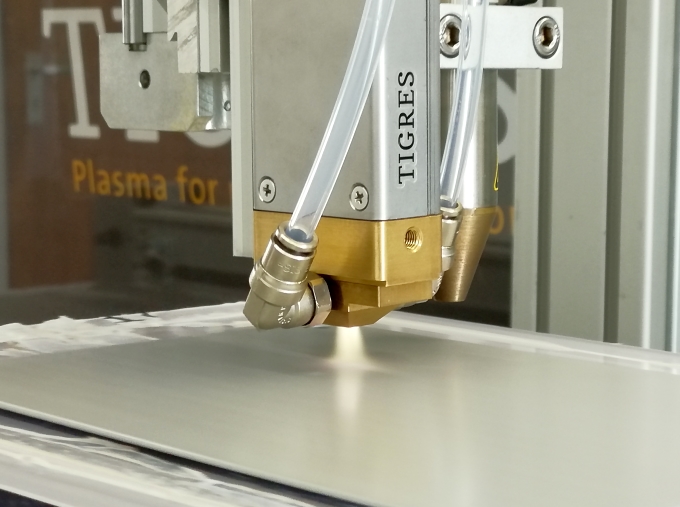
The location where the precursor is fed in can play a major role. One plasma tool that is very well suited for coating is the Plasma CAT600 (Figure 2). Thanks to its patented discharge principle using two electrodes, the monomer gas is fed into the discharge zone but outside the area of the electrode and counter electrode. This prevents parasitic coating of the electrode or counter electrode and ensures consistent plasma discharge quality. The Plasma CAT600 has a rated power of 600W. This is a power range in which, for example, the HMDSO monomer gas is well converted. The layer properties can then be influenced by adjusting the monomer flow rate.
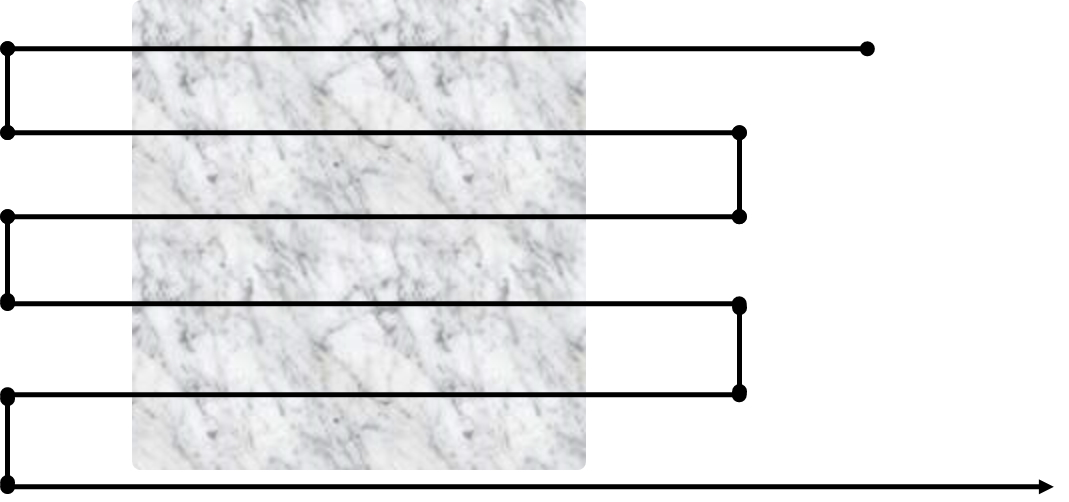
For a (broad) surface coating, the surface to be coated is scanned with the plasma tool. Depending on the build-up rate of the layer thickness, which is influenced by the plasma dose and the monomer flow, a specific scan pattern is preferable for a certain homogeneous layer surface. Investigations carried out as part of the PlaCoW project¹ (Plasma Coating for Wood) with the project planner Innovent e.V. from Jena showed the following results for a hydrophilic (“adhesive”) coating.
The coating was applied using the following parameters:
- CAT600 plasma tool, power setting 100% (600W)
- Processing speed 200 mm/s (12 m/min)
- Working distance 10 mm (distance between nozzle opening and substrate surface)
- Monomer flow 1 ml/min (HMDSO, gaseous, Sura Instruments STS evaporator)
The substrate surface was scanned during coating by the plasma tool as outlined in Figure 3.
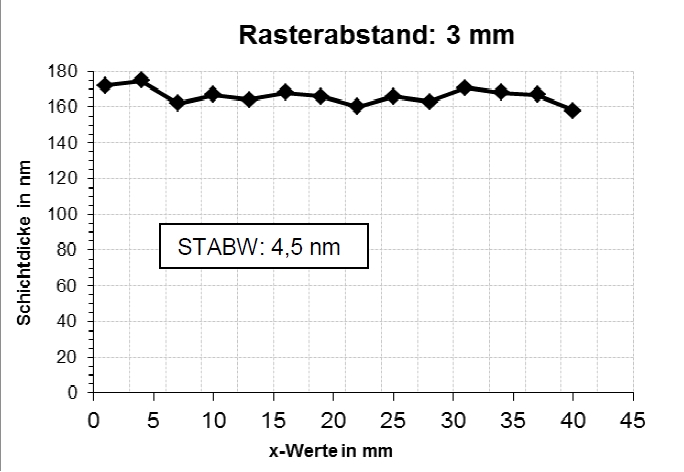
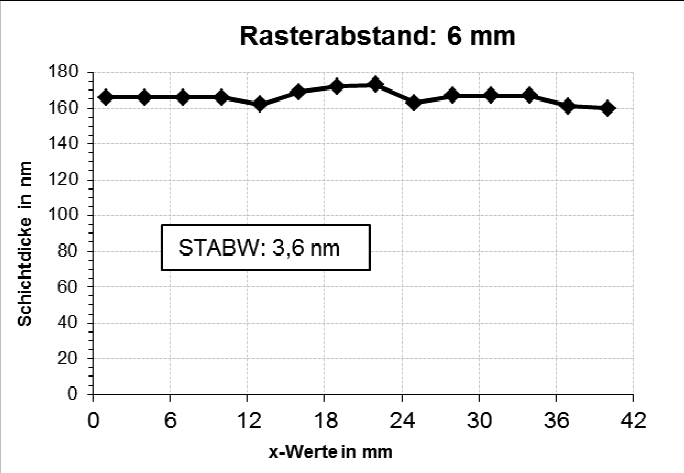
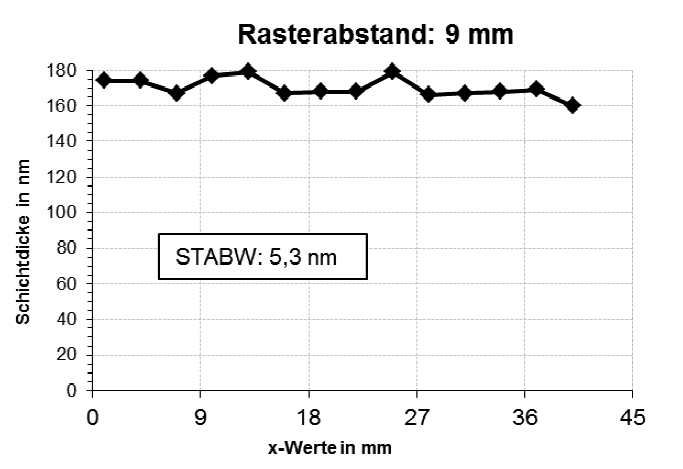
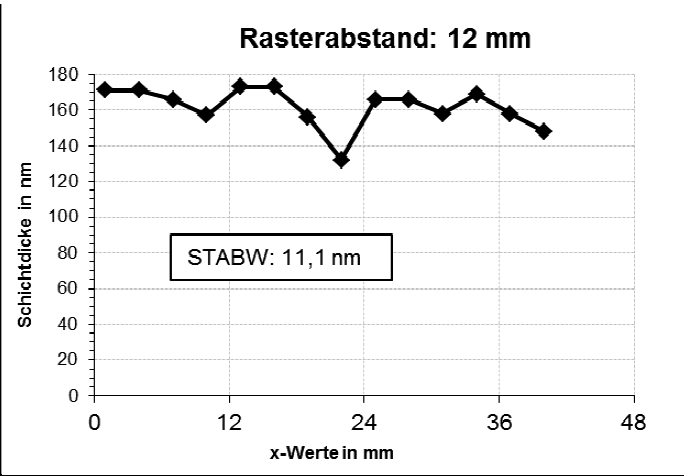
Grid spacings (distance between two coating tracks) of 3 to 12 mm were used. The homogeneity of the layer thickness was then examined using a profilometer.
For the above-mentioned coating parameters, a grid spacing of approx. 6 mm (Fig. 5) would be recommended. The layer thicknesses shown in the figures (Fig. 4 to Fig. 7) were generated by passing over the surface several times. The build-up of the layer thickness is influenced by the setting of the degree of fragmentation (plasma power, monomer flow) and the process speed. With only one pass at a high degree of fragmentation (plasma power set to 600 W, 1 ml HMDSO flow) and a process speed of 12 m/min, very thin layers of approx. 10 nm can be achieved.
The areas of application for AD plasma polymerisation
With suitable deposition parameters, coatings can be produced for different purposes. Corrosion protection coatings, for example, should be deposited as a closed film without pinholes. Very thin coatings with thicknesses of less than a nanometre serve as plasma primers to promote adhesion on materials with critical, non-polar surfaces. Substrates with inhomogeneous surface properties can be prepared for further processing by the homogeneous surface energy of the coating. By embedding additional functional agents (silver, copper, etc.) in the HMDSO matrix, so-called composite coatings can be produced. Such components are embedded in the HMDSO matrix as secondary precursors during coating (e.g. as dissolved metal salts AgNO₃, Cu(NO₃)₂, etc.).
¹ EraSME Project: Plasma based surface modifications of wood and wood polymer comosites (WPC) materials and the application of electromagnetic fields for wood and WPC treatment “#Plasma Coating for wood” – PlaCoW, INNOVENT Jena e.V. / FB Oberflächentechnik