What exactly is plasma?
Plasmaunderstandablyexplained
What is plasma? We often encounter this question in conversations with potential customers who have not yet used a TIGRES system for plasma surface treatment.
Basically, plasma is a state of aggregation of any matter. The state of aggregation of a substance ultimately differs only in terms of its current energy intensity or the vibration intensity of the molecules of that substance.
There are four states of matter, the first three of which—solid, liquid and gaseous—are well known from our everyday environment. The fourth state of matter is plasma, which is explained below.
As a simple example, we will choose water as our material, since three of the four states of matter are already familiar to us from everyday life.
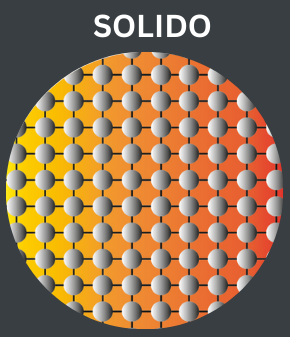
The first state of matter (SOLID)
When a substance is very cold, its molecules either do not vibrate at all or vibrate very slowly. In this state, the substance is solid.
In our example, cold water below 0°C is solid. The water molecules are arranged in a solid lattice structure.
Water in this state is called ice.
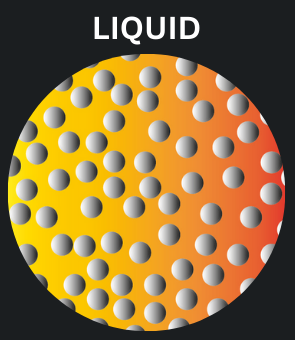
The second state of matter (LIQUID)
When energy is added to ice, e.g. in the form of heat, the ice molecules begin to vibrate and, once a certain amount of energy has been added, can no longer maintain their lattice structure.
The molecules move quite close together but still freely in space. Thus, the matter has changed from a solid state of aggregation to a liquid state of aggregation.
Solid ice turned into liquid water through the addition of energy.
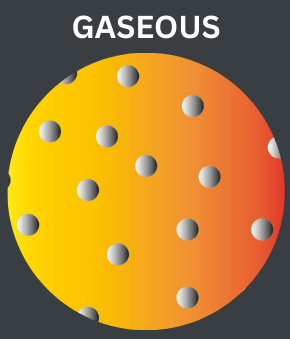
The third state of matter (GASEOUS)
If energy, e.g. heat, is continuously added to the liquid water, the water molecules vibrate faster and faster. This means that they have to move further and further apart in order to vibrate more strongly.
Above 100°C, the molecules now require so much space that they assume a new state of aggregation.
Liquid water turns into gaseous water vapour.
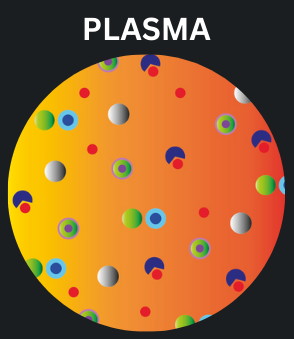
The 4th state of matter (PLASMA)
If further energy is added to the molecules of the gaseous water vapour, e.g. in the form of heat or electricity (in nature, e.g. in the form of lightning), the molecules of the water vapour ionise. This means that the additional energy causes a large proportion of the molecules, which are freely oscillating in the gaseous state, to split into ions and free electrons. In addition, highly excited species such as fragment molecules, which are missing ions or electrons, remain.
It is a high-energy gas with many differently charged particles.
Gaseous water vapour has become a high-energy state called plasma.
This example also shows that the states of aggregation are reversible. If energy is now removed again, the process reverses in the opposite direction.
If the plasma (4th state of matter) is removed from the energy source, the high-energy free charges in the plasma find their opposite pole again and after a short time the plasma returns to its gaseous state (3rd state of matter).
If energy continues to be removed from the gas, it becomes liquid (2nd state of matter).
If energy continues to be removed from the liquid, it becomes solid (first state of matter).