ZIM Collaborative project - VascuPla
Development of improved vascular medical devices based on high-performance polymers and applied atmospheric plasma processes
The project was supported by the BMWK (from May 2025: BMWE, Federal Ministry for Economic Affairs and Energy)
Project partners
Company:
1
ALPO Technik Medical Products GmbH & Co. KG
Manufacturers and plastics processors in the medical devices industry
2
TIGRES GmbH
Manufacturers of plasma equipment for atmospheric plasma applications
R&D institutions:
3
INNOVENT e.V. Technological development Jena
A research institute with close links to industry in the field of surface technology, including plasma technology (APPCVD), CCVD, sol-gel and electrochemistry
The partners' sub-projects
Topic of the sub-project
ALPO Technik Medical Products GmbH & Co. KG
Development of vascular medical devices, extrusion processes and plasma-assisted bonding and printing techniques
TIGRES GmbH
Development of modular atmospheric pressure plasma systems for the surface pretreatment of tubular medical-grade plastics
INNOVENT e.V. Technological development Jena
Atmospheric plasma processes and APPCVD adhesion-promoting layers for tubular medical plastics
Initial situation
In everyday life, we encounter plastics in a wide variety of forms – from packaging materials to light switches, appliance casings, textiles, toys, household goods and protective equipment – the list goes on and on.
Plastic materials are also ubiquitous in the field of medical technology, particularly as tubing material, for example for catheters, feeding tubes for artificial nutrition, endoscopy tubes and much more. On the one hand, these materials must meet stringent requirements; on the other hand, however, costs to the healthcare system must be kept as low as possible.
Many plastics, which are of particular interest to the medical technology sector due to properties such as chemical resistance, biocompatibility or a low coefficient of friction, are, however, difficult to bond or print on.
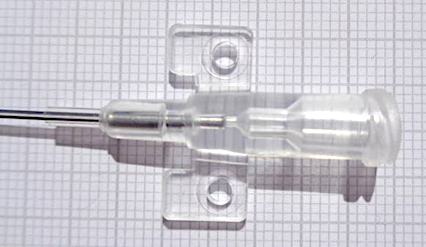
For example, PTFE is ideally suited for medical devices that come into contact with blood. However, the joining of different plastic components is essential for the manufacture of such medical assemblies, as is the case with an arterial catheter, for instance, where the tube is made of PTFE and can only be connected to an acrylonitrile-butadiene-styrene adapter via a metal sleeve.
Results and outlook
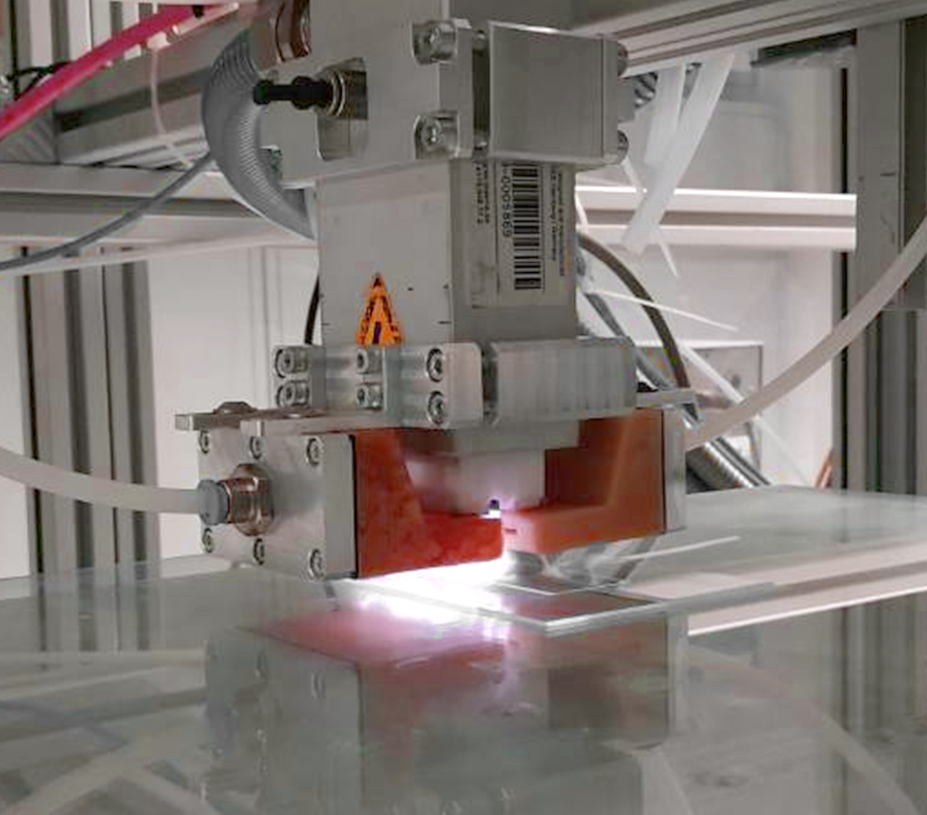
By applying a suitable plasma treatment to the outer surface of the tubing, it was possible to achieve direct bonding between the tubing and the plastic connector, thereby simplifying the assembly of vascular medical devices. The requirements regarding adhesion, sterilisability and storability of the composite samples were met. Furthermore, the printability of the tubes with markings and measurement scales was significantly improved. On the plasma technology side, the project involved the development of activation and coating processes using two types of modular plasma systems, the T-JET and T-SPOT.
The homogeneity of the emitted secondary plasma is of great importance for the generation of a linear plasma. To achieve this, the nozzles of the individual tools must deliver consistent quality even during continuous operation and at high cycle rates. Several sub-projects were carried out to ensure the effective functionalisation of the tubes: precursor dosing, coating nozzles, tube rotation holders, and APPCVD adhesion promoter layers, including comprehensive analysis.
Throughout the project, and also after its completion (September 2024), the project results achieved up to that point were publicised in collaboration with the project partners in the form of articles in specialist journals, presentations, technology demonstrations and technical discussions at trade fairs.
The findings of the publication can be viewed online in the idw (Science Information Service) press release:
The original article was published in the Journal of Electroplating, November 2023: